On the night of the 16th of April 1907, two tragic deaths happened at Ferniegair, these deaths were not connected to one another, but both very tragic & unfortunate.
David Barrie who was only age 15 and was employed at Allanton Colliery as a Haulage man had not long finished his shift and was heading out to play a game of football with his friends.
At the time of David’s death, he lived at 11 Allanton Terrace in Ferniegair and had he was killed only yards from his front door. Crossing the Lesmahagow branch line of the Caledonian Railway, he crossed at the section between Allanton & Hamilton Rows to get to the football field where he was struck by a passenger train and he was killed instantly.
David was said to have been a very bright and kind pleasant boy and his parents were said to have been totally grief stricken.
Entrance to Allanton & Hamilton Rows.
His mother later wrote a notice of thanks in the Hamilton Advertiser for the many bunches of flowers sent to the family. Hamilton & Allanton Row’s have long been demolished and the area where they once stood has been reclaimed by woodland, the Lesmahagow branch of Caledonian railway was closed to passengers on the 4th of October 1965 and was reopened 40 years later as the Larkhall to Hamilton branch on the 9th of December 2005.
The second death to occur on that same night was that of John Nisbet age 38.
John Nisbet, also, of Ferniegair was a brushing contractor working at Ross Colliery. He and another workman had been working deep underground in the pit when he set 3 charges of dynamite for the purpose of blasting.
Having fired the fuse, they both ran off to a safe distance to wait on the charges going off and having what they mistakenly thought was 3 charges detonating, it unfortunately turned out to be only two, one of the charges must have caused an echo.
John went to proceed and check that his work had been successfully completed and went forward to examine the section of the mine when the third explosion detonated late. John’s head was completely blown off.
In 1907, accidents were frequent in Hamilton’s coal mines and only 4 days prior to this, another man was killed at the same colliery.
Both David Barrie & John Nisbet are buried at the Bent Cemetery side by side each other, one notable feature of the headstones is that John’s still looks good to this day and David’s has been weathered away. This tells us that John being killed while at work likely had his headstone paid for by the Ross colliery and David’s would have been paid for by the family.
Hamilton objects are scattered all across the world and that’s a fact! They turn up everywhere and I was delighted when a lady named Kim got in touch with me and told me that an old food jar had turned up at her charity shop in Dumfries.
Kim was looking to put a value on the old Hamilton Jar and as I collect anything that’s old and comes from Hamilton, I offered to buy the jar from the charity shop, so the next Saturday after I spoke with Kim, I got in my car and did the one-hour drive down to Dumfries to collect this old relic of Hamilton.
Hamilton during the 19th century had its fair share of grocers, none more popular or larger than Keith’s, who was the largest of them all and William Cowan was one of the smaller local Hamilton grocers but I have to say, William Cowan’s grocery shop was a shop that I have never heard of, so I decided to find out who William Cowan was.
I found that William was actually born in 1848 at Moffat in Dumfriesshire, just up the road from where the jar was donated to the charity shop. William lived here with his parents until his father got a job as a railway porter in Hamilton.
William, born on the 19th of July 1848 at a place called Middlegill near Moffat, Dumfriesshire to parents Hope Johnstone Cowan & Janet McCaughie, his father was a railway porter, and his mother was the home maker.
By 1851 William is living with his mother and siblings in Moffat, however, on that day that the census was taken, his father does not seem to be living with them. I did find a man called Johnson Cowan working as a farm laborer living and working at Whitecastles Farm in Dumfriesshire, however, I can’t confirm if this is the same person as Hope Johnson Cowan.
The family made the move to Hamilton between 1850 & 1853 and we next find the Cowan family on the 1861 census where the family are living at Burnbank Road, the Cowan family had grown, and William had eight siblings two of them were twins.
At this time, William, aged 12 had left school and is working as a grocer’s message boy, and we find his dad working locally as a railway porter. Burnbank at this time was not yet joined to the wider Hamilton but was more of a rural community, this was before the three large coal pits were opened at Greenfield, Earnock & Clyde which changed Burnbank forever.
At some point between 1861 & 1871, William is living away from his family at Beith in Ayrshire, and it is possible that he has found himself an apprenticeship with a local grocers merchant and it is sometime around 1871 that he meets a local Hamilton girl called Jessie Hamilton.
Jessie Hamilton was five years older than William and at the age of 30 when she married him and at the time this was quite the age, William five years younger at twenty-five was also considered to be married at an older age, perhaps they both had concentrated on building their businesses and time had simply just drifted by.
Jessie Hamilton was the daughter of shop keeper, her father was James Hamilton, and he was a Master Baker employing 3 men & 2 boys and one of these boys was none other than William Cowan’s wee brother Hope Cowan who was employed as an apprentice baker. There is a possibility that this is how William & Jessie met.
The Hamilton family lived at 89 Townhead Street and were wealthy enough to have a servant and all of Jessie’s siblings whose ages ranged between the mid-twenties to the mid-thirties.
On the twenty fourth of August 1872 tragedy struck William Cowan’s family when his mum passed away at the age of 54. She had been suffering from an illness for the past eight years and had succumbed to it. William’s father had also recently become a Goods Agent for the Caledonian Railway Company, so it was bittersweet times for the family. William, who was still living at Beith travelled up to Hamilton and he was the person who registered his mother’s death.
William’s father remarried on the twenty fourth of November 1875 when he met a woman from Partick in Glasgow, her name was Margaret McKay, and there is a possibility that none of his kids had attended the wedding as none appeared to have been witnesses recorded on the marriage certificate.
By 1875 William & Jessie had returned from Beith and back to Hamilton, they had started their own family, and they now had little James, Margaret & Jessie and it’s in these names that I suspect that William did not have a great relationship with his father.
The first-born son usually takes the name of the fathers’ father; however, James was named after Jessies dad. The second daughter Margaret was named after Jessie’s mother and the third daughter named Jessie, possibly after William’s mum, or could it have been named after his wife Jessie? There could be another possibility that Jessie was the boss in the house, and she decided on the names of the children. Back in these days it was typically the man who named the newborn.
When William and Jessie arrived in Hamilton they rented at a house in Miller Street, where they lived and grew their family and William opened his first shop with its own cellar at 2 Duke Street in Hamilton’s New Cross (Which later became the Royal Hotel) where the popularity of his choice of foods allowed him to then expand and have another outlet at Low Waters which would have been a small outlet but nonetheless, Low Waters was a long walk down to Hamilton Town Centre, so he brought the shop to the people that lived a more rural life up the hill.
William’s life away from his work, he was an ardent gospel-temperance worker and a well-known figure on the evangelistic platform and was a member of St. John’s Church and he eventually was appointed to eldership and did great work in various capacities for the St, John’s congregation.
On two occasions William sought to enter the Town Council as a temperance candidate, but was unsuccessful on both occasions, however still wanting to do good for Hamilton, he was made Justice of the Peace for Lanarkshire and notability he was appointed to take evidence in the famous Coatbridge Case.
William Cowan’s shop was known for providing quality foods, locally sourced and some imported, he sold items such as Tea, Sugar, Corn flour, Barley Rice & Peas, Irish Butter, Ham, Smoked Hams, Jellies & Marmalades & Biscuits and households who placed orders and lived a bit further away could have their provisions delivered by William Cowans very own horse & carts.
William Cowan had firmly established his new business in Hamilton and by 1878 he lived at 99 Quarry Street, he was a popular Grocer & Provision Merchant, and he must have been doing well as he employed two men & 2 boys, he even had a servant living with the family named Grace Cross.
Number 99 Quarry Street today is used as an office building for a lawyer, but back in William’s day, it was a two-story charming townhouse, and it had enough space for his family & servants.
Tragedy was to strike the family again when on the 8th of November 1878 William & Jessie’s son William died at the house on 99 Quarry Street. The poor boy was only five years, six months old when he died of diarrhea.
By June 1887, Quarry Street had a new modern building constructed and to commemorate the coronation of Queen Victoria, this new building was given the appropriate name of Victoria Buildings.
There was quite a number of established businesses who quickly made the move into the new grand Victoria Buildings and William Cowan was one of the first. He rented two units which were 25 & 27 Quarry Street and the move to the busy bottom cross was underway.
William regularly advertises the move of his business all the way up to November that year, so perhaps his decision to move premises further down the road was not working out for him. Why did he need to put out so many adverts in the Hamilton Advertiser, did his custom not follow him, or was he just not getting enough customers through the door to sustain the high rents that he was paying.
By 1891, we next find that William & Jessie have moved out of their central townhouse on Quarry Street and they have moved to Fernlea on Park Road and this is when the family go through some tough times that begin with his wife Jessie passing away of breast cancer.
Jessies was 51 years old and she had been suffering the illness for the past year. She died on the 26th of August 1892 at Fernlea and this was just the beginning of Williams grief when William’s father Hope later died on the 20th May 1895 at 13 John Street and William is the person who registers the death.
Tragically, William’s youngest daughter Agnes Marie dies 1st May 1901 at Fernlea, she had been suffering from tuberculosis, the past 10 years had been relentless for William.
William did find love again and eventually remarried three years after his wife’s passing. He met a woman from East Bowhill Farm in Cummertrees, Cumnock called Barbara Rae, who was a farmer’s daughter. Barbara was fifteen years younger than William and she lived quite far away from Hamilton, so it is a possibility that her father was a supplier of dairy products to William and this is how they met. They went on to have two sons, one called William-Rae and the other Fergus. On the day that Fergus was born the 1901 census of Hamilton was being taken and the enumerator recording the 1901 Census had knocked on the family’s door when the baby boy was only 6 hours old, he was yet to be named.
William & Barbara decided to leave Park Road and Hamilton for good, they sold up their properties and left for Canada, William would never return to Hamilton, nor Scotland again. He had members of his family who had previously emigrated to Canada and were very successful which may have been some of his siblings and this may have been why William made the decision to emigrate.
Barbara starts the journey to Canada and she leaves on a ship called the SS Corinthian which sails from Greenock to Montreal, Quebec and it arrives 7th of June 1904, accompanying her on the journey are their kids James, Margaret, Rae & Fergus. Jessie stays behind with her father to help wind up their properties & businesses. In late August 1904 William and Jessie boarded the SS Pretorian and they arrive at Montreal, Qubec Canada on the 5th of September of that year, they would never return to Hamilton.
William Cowan settled in Canada very quickly and he became embedded in the community and I never seen any evidence that he stayed in the business of being a Grocer & Tea Merchant but when he arrived in Toronto, he worked for the Toronto Pharmacal Co. He was prominently known in church circles and was a member of the parochial board which administered the poor law.
William seen out his last days in Toronto, Canada and on the 28th of December 1910 he was struck down with a urinary tract infection, he passed away at his home, 216 Cottingham Street. He was laid to rest at the Mount Pleasant Cemetery, Toronto which was only a short walk from his house.
William’s second wife Barbara was devoted to William and before her death, she did return to Scotland in May 1932 and arrives at Greenock, she has her son William Rae Cowan, who is now 33 and is working as an engineer, she is now 69 years of age.
The last trace that I found of Barbara and her son William was in July 1934 when we see them returning back to Canada on a ship called the SS Duchess of York that sailed from Greenock.
During WW2 the SS Dutchess of York was recommissioned by the Royal Navy as a troopship and used early in the war to transport Canadian soldiers to Britan, returning to Canada carrying RAF crew & German prisoners of war. In 1943 she was attacked by enemy aircraft and all but 27 people were saved, the ship burning and badly damaged the ship was sunk by the Royal Navy the next day, she now lies at the bottom of the ocean.
Barbara returned from Scotland to the family home of 216 Cottingham Street, Toronto after being in Scotland for the past two years, she died in 1939 and is buried alongside William, along with their daughter Jessie & son James.
Today the grand large house of 216 Cottingham Street still stands and thanks to Google Maps, we can see the last residence of William Cowan, Hamilton’s Family Grocer & Tea Merchant.
Not the actual 1856 Leechlee Street Cesspit. For visual reference only.
The supply of water to the inhabitants of Hamilton was in 1856 very inadequate, both for drinking and other sanitary purposes, the majority being, in most instances, dependent on the arbitrary will of their neighbor’s for a supply from their private wells.
Long before the days where fresh water was to be piped directly into people’s houses, a terrible accident happened at Leechlee Street. On Wednesday the 2nd of January 1856 a well-known street character and Spaewife (Fortune Teller, or witch) known as Lizzie Steel who was known to be of intemperate habits died under shocking circumstances.
Poor Lizzy had been in her Leechlee street back yard where she drowned or was suffocated in the building’s cesspool. The state of the back premises in this and other Hamilton streets that were inhabited by the poorer inhabitants of the town loudly called for the attention of the board of health.
The middens and cesspools that lay in many of the poorer classes back yards were offensive and were giving very dangerous health issues to the townsfolk. They were dangerous to health and very hazardous to children and others going about in the dark.
One of these midden-steads was a tank said to be four feet deep and fully six feet square and was said to be quite easy to drown a person stumbling into it, and there was no fence to prevent such an accident.
Who was to blame for permitting the existence of such horrible man-traps and fever-breeders? The death of Lizzie Steel in such terrible circumstances would have later assisted the Hamilton Water Works get some traction and form the towns very first private water company.
Did you know that Peacock Cross was Hamilton’s very first area to have piped water brought to it?
The story of Hamilton’s very first water supply being piped to the town is currently being written and will be available very soon on Historic Hamilton.
On the Monday 29th of June 1953, her Majesty the Queen was on a tour of Lanarkshire and on that sunny day, she visited Hamilton. Golden sunshine poured down like a benediction upon Her Majesty, the Queen. Radiant beside her husband, the Duke of Edinburgh, as she travelled through Lanarkshire that Monday in a gleaming, open car bearing the Royal Standard.
From Lanark, where she inspired a guard of honor provided by the 1st Battalion The Cameronians (Scottish Rifles) and paid a brief visit to the royal burgh’s civic centre, Her Majesty rode by Carluke and Wishaw to Hamilton along an almost continuous avenue of spectators. There was cheering all the way.
When the royal party left Lanark they were ahead of the scheduled time, but as they passed the Law hospital, where many patients waited, some popped up in beds placed near the roadside, the Queen instructed her driver to go slowly. They crawled past the Law hospital and wherever there were school children, they moved very slowly, so that all could have a glimpse of Her Majesty.
Hamilton had given the Royal couple it’s “biggest, brightest and cheeriest.” Reception. Amusingly the proceeding police cars were ‘booed’ by the school children, but when the Queen and Duke came along, what an ovation they received.
At Hamilton’s Municipal Buildings, which the Queen and her entourage reached about 10 minutes behind scheduled time, the roar of the acclamation reached its zenith as the Royal couple stepped from their car to be received by Major J. B. L. Monteith, Vice-Lieutenant of the County.
Before entering the building, Major Monteith presented Provost Mrs Mary S. Ewart; Mr. John Mann, Convener R. St. G. T. Ransome, Commander of the Scottish Beach Brigade (T.A.)
When the Queen and her husband passed through the main doorway of the bravely decorated Cadzow Street building, opened on May 9, 1914, by King George V, they were accompanied by the provost and county convener. In a following group were the Vice-Lieutenant of the county, the right Hon. James Stuart Secretary of state for Scotland; the Lady Alice Egerton, Lady in waiting; Sir Alan Lascelles, the Queen’s private secretary; Major Edward Ford, assistant private secretary; and Captain the Viscount Althorp, equerry-in-waiting.
The appearance of the Royal couple in the doorway of the lecture room of the public library was the signal for a spontaneous burst of applause from the assembled guests, numbering over 160.
Her Majesty, who smilingly acknowledged the welcome, wore a state-grey silk coat over a green dress shot with silver. A neat little green feathered hat adorned her head. Her shoes, gloves, and handbag were black. A necklace of pearls encircled her throat and on her ears were pearl earrings. Pinned to her coat was a diamond brooch in the shape of a bow. A pace behind the Queen as she entered came through the Duke of Edinburgh, wearing a dark, pin-striped suit.
First to present to be presented to the Royal visitors by the provist was the Town Clerk. Then in turn, Mrs Ewart introduced Mrs Kelly, Ballie and Mrs James Mackie Mackie, Baillie Mrs Elizabeth MacDougall, Baillie and Mrs Gavin Cockburn.
Were you one of the people in the crowd? Can you remember that bright Monday afternoon? Share your memories with us.
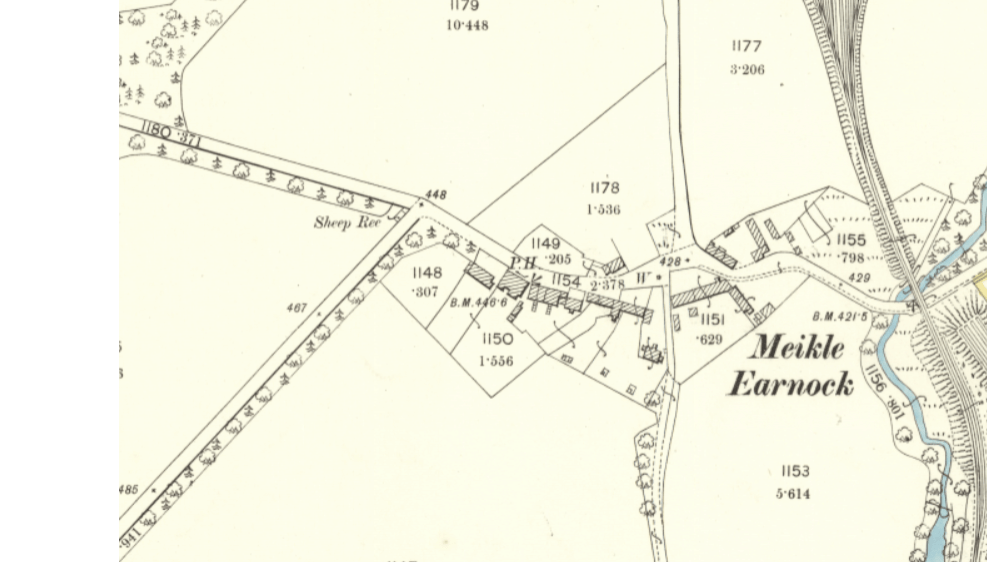
On Thursday the 17th of July 1862 the quiet little hamlet of Meikle Earnock was thrown into a state of alarm and fear by the presence of a woman’s blood-stained clothes which were found in a field. Before I tell you of the circumstances surrounding the incident of the blood-stained clothes, I first have to tell you that as the story unfolds, the murder did not happen in Hamilton, but 17 miles away in Anderston in Glasgow, however, for a few days it was reported that the murder took place here! a correspondent from Hamilton whose name is lost in the mists of time recorded a very detailed account of the findings.
In 1862 the village of Meikle Earnock was a very quiet countryside hamlet and it was full of country folk who lived here and not much happened, so when this story made headline news, the little community of Meikle Earnock was in mass panic as they believed that they had a murderer amongst them.
The notes of the place and which circumstances in which the fragments of clothing were discovered were very detailed, however, trying to pinpoint the location of where they were found is proving difficult and I have narrowed it down to the land where the road splits from Low Waters and you can go right up on to Meikle Earnock Road or left to Strathaven Road.
The old Meikle Earnock Road.Location of Mrs Gibson’s Inn & the area where the blood-stained clothes were dumped. The closest location to the Tommy Linn Burn – Now called the Cadzow Burn.
The reason for not pinpointing an exact location of the blood-stained clothing is due to two things, one is trying to find a map series that can show a clear layout for 1862 and the second reason is down to the construction of Eddlewood Colliery which ripped through much of this area. There are also a number of old by roads and old rights of way footpaths leading from Meikle Earnock to Strathaven Road and in 1862, they would have been commonly known as “The Eddlewood Road” and the “Strathaven Road”, these old roads & paths are now mostly overgrown and would be hard to find but back in the day, they would have been used by most of the residents and travelers not wanting to have to cut down through Hamilton to get to other towns & villages.
In 1862 the Eddlewood Road was parted from the one leading to Strathaven, the closest hamlet was Low Waters, and the two roads were separated by an angular termination of two hedges, which bound a field, on the east side of which ran to the Strathaven Road, and the west the Eddlewood Road, both diverged wider apart as they ascend.
The point referred to was in reality the apex of an irregular sided triangle, the base which was formed by a crossroad from the toll on Strathaven Road, which joined the Eddlewood one, where it turns more to the right and becomes shady with fine trees. A short distance onward there were two quarries just outside of Meikle Earnock. (Back in 1862 the writer describes Meikle Earnock as a small village of some antiquity).
The clothes were found in these fields and when gathered by the police, and one petticoat (Which had been taken home by a local woman) after it was found in her house in Meikle Earnock. It did not do to judge one hastily, but it is true referring to the much spoken of zeal and diligence of the local police in that era, that it was known to some locals on Thursday & Friday, that bloody clothes were lying in the quarry park and on the following days, it was well known, as on both of those days groups of children and grown-up people went and looked at the blood-stained clothes; and one woman as was noticed, took away a flannel petticoat which the cattle had not damaged.
The blood had evidently exited the grazing cattle in the field, as they had tossed them wildly about. The gown appeared to have been trimmed with a fringe, as the curious boys when viewing the bloody fragments invariably raised up on sticks, the long fringe bordered skirt of a silk dress.
In the neighborhood at the burnside a penknife was also found wrapped up in a pocket handkerchief, which was believed to have been found by a boy who lived at Low Waters and it was rumored to have still been in his possession. Not far off from this spot a child’s frock and pair of stockings was also found, all of them apparently torn and tossed by the cattle in the field. The bloody clothes were known to have been lying in the field for four or five day’s before the police, notwithstanding their carful search, came to know of them, a fact which exited considerable surprise at the time in the neighbouring village, which is just two miles from Hamilton.
The woman who was rumored to be a Mrs McLachlan was seen on the Eddlewood Road with a bundle under her arm and went into the Inn kept by Mrs Elizabeth Gibson at the upper end of Low Waters and got a ‘dram’, but the people there could not say positively whether she had a bundle or not. After leaving the house, she appears to have chosen the Eddlewood Road on account of its rural sequestered appearance, and to have proceeded up it to the crossroad already spoken of whatever further.
It was a matter of conjecture among the villagers whether or not there has been design cunningly displayed, in order to mislead, by the handkerchief and pen knife, and the child’s frock and stockings, being found so near to the bloody clothes.
The quiet little hamlet of Meikle Earnock was thrown into a state of alarm and fear by the presence of the bloody clothes, which did take some time to effectually remove.
On the day in which the clothes were dumped Jessie McLachlan had come from Anderston over to Hamilton by train. It is unclear why she had chosen to visit our town to dump the blood-stained clothes, she perhaps knew someone who lived here. However, she left the train station at Hamilton central and walked up the Low Waters Road. During her journey she had in her possession a box which at different stages of her journey she had asked for the station masters at each end to send for a boy to carry the box.
When she reached Low Waters, she topped at the Inn for a ‘Dram’ and she paid a penny for it. Mrs Gibson who ran the Inn saw that she was tiered looking and poured her a half glass of whisky to try and perk her up. She was a stranger to Hamilton and when she reached the Inn the box in which she was carrying had been left behind somewhere and she how had the blood-stained clothes wrapped in a handkerchief.
After she had her drink, she headed in the direction of Meikle Earnock and before she left the Inn, she asked the daughter of Mrs Gibson who was called Elizabeth “Could you tell us a burn where to get a drink o water, for all the lang road that I have travelled I havena a burn or sheugh whaur a person micht wat their lips”.
Elizabeth told her of a nearby burn near a gate and pointed her in the place that leads to the Tommy Linn Burn – ‘Today, we call this the Cadzow Burn’. Jessie McLachlan was last seen going up the road and passing the big oak tree going onto the direction of Meikle Earnock, the bundle of clothes still under her arm.
Little Elizabeth Gibson later that day was playing up the road at the Tommy Linn Park and she found some flannel clothing in the hedge. When she pulled them out, she found them to be blood stained and being frightened by what she found she ran away home.
The next day she told her friend who was called Marion Fairley about her discovery and the two kids walked back up to the Tommy Linn Park to have another look at the bloody clothes. The next time she went back, she took another friend who was called Janet Cameron and the police were at the hedge, the police Officers name who was first in attendance was called Daniel Stewart and he was the PC who had taken the clothes away from the scene. It was then found that on the opposite side of the Inn, a park which was known to the locals as Templeton Park, that more blood-stained clothes were found scattered.
This story made the national news across the country and pressure was on the Hamilton police to quickly track down the murderer. Attention was very quickly drawn to the woman who was called Jessie McLachlan and she was quickly apprehended and from the start, Mrs McLachlan denied that she had anything to do with the murder.
Jessie McPherson’s death certificate.
The Hamilton police worked fast and efficiently and full credit was given to them for the quick apprehension of Mrs McLachlan. However, this was a Glasgow murder and not one which happened here in our town. Superintendent Dewar of the Hamilton district police sent a telegram that same night to a Captain McCall of Glasgow to “hand over the case”. The woman who was murdered was called Jessie McPherson she was 38 years old, and it took place at 17 Sandford Place, just off Sauchiehall Road in the Anderston district of Glasgow.
A full investigation was carried out on this murder and it went to trial in September that year and it was found that Jessie McPherson sadly was the best friend of Mrs McLachlan. She was the servant for the owner of the house where she was murdered.
She was brutally murdered with a meat cleaver at 17 Sandyford Place. She had stab wounds all over her body, including long, deep gashes across her forehead and the back of her head, which had cut through the bone.
There was blood all over the bedroom, lobby and kitchen, and some of the victim’s clothing and belongings (as well as some silverware from the house) had been stolen. But, strangely, the kitchen and bedroom floors had recently been washed, as had the face, chest and neck of the corpse.
The correction of entries for Jessie’s murder 1862.
With bloody footprints still visible, however, the murderer had done a pretty bad job of cleaning up the crime scene. The first suspect was James Fleming, the father of the owner of 17 Sandyford Place. Fleming was staying alone in the house at the time of the murder, and (given his previous history of getting a servant girl pregnant) it was thought that he may have murdered McPherson after she refused his amorous advances.
A pawnbroker, who had read the story in the newspaper, said he had received the missing silverware from a woman called Mary McDonald – a name sometimes used by Jessie McLachlan, a former servant at 17 Sandyford Place, and best friend of the victim. McLachlan was arrested and gave a statement to police, but they found that most of what she said was a lie. The discovery of blood-stained clothing in her house made the suspect seem even more guilty.
The Sandyford murder was the first Scottish police case in which forensic photography was used to help solve the crime. Police asked McLachlan to place her foot in a bucket of cows blood and then step on a plank of wood. They then matched this bloody footprint to a photograph of one at the murder scene.
Despite McLachlan maintaining her innocence, she was convicted of the murder and sentenced to death. Due to public outcry, this was reduced to life imprisonment. Many experts now think she was innocent, and her story of walking in on Mr Fleming while he was murdering McPherson might just have been true.
On further investigation of this story, I found that Mr Fleming was at first arrested for Jessie’s murder and was somehow let off. The police did say that if any new evidence had come to light that they would re-arrest him, so in my opinion, the Glasgow police did suspect him of the murder, but they found no evidence.
I also found that after Mr Fleming was released from police custody, he only hung around Glasgow for a few days! He boarded a 2 pm train down to Greenock accompanied by two relatives. He at once getting off the train continued down to Gourock where he boarded the steamer Vulcan and then crossed over to the Dunoon where he lived with his son. It is unknown where he lived after that, however by him fleeing the area, I ask, does that sound like an innocent man to you?
Story researched and written by Garry McCallum – Historic Hamilton.
The Council Headquarters building, on Almada Street, Hamilton, was built as the Lanark County Buildings in 1963, and designed by Lanark council architect D G Bannerman.
The 16 storey, 165 foot tower is the largest in Hamilton, and is a highly visible landmark across this part of the Clyde Valley. The modernist design was influenced by the United Nations building in New York.
Glass curtain walls cover the north and south facades, with the narrow east and west sides being blank white walls. At the front of the building is the circular council chamber, and a plaza with water features. It is known by the Hamilton people as the “County Buildings”.
The building today is still Hamilton’s best known landmark and in previous years people have used the fountain at the front to cool down in hot summers and there have also been brave people abseiling down the side of the building to raise money for charity.
I have never been in the county buildings, but maybe someone who works in one of the top offices could get a picture for us all to see the remarkable views over Hamilton.
The Hamilton fighter won Scottish, British, European and Empire titles before defeating Italy’s Salvatore Burruni at Wembley over 15 rounds to land the world flyweight title in 1966.
In McGowan’s next fight, he won the British and Empire title at bantamweight when he defeated Alan Rudkin, again at Wembley.
He won 32 of his 40 professional fights before retiring in 1969.
McGowan had been in poor health in recent years and was living in a nursing home in Bellshill.
He died peacefully at Monklands Hospital on Monday night.
One of 10 children, McGowan is survived by a son and daughter and a grandson and grand-daughter.
In the picture is Andrea MacSkimming as the gala queen 1985. With. Left is andrea and right is jane. As the maids of honour, Picture courtesy of Johnny MacSkimming.
What was your memories of the Eddlewood Gala Day? Do you have any pictures that you would like to share?
Andrea MacSkimming as the gala queen 1985. With. Left is andrea and right is jane. As the maids of honour.
John Mills sent us a picture of him and his two younger brothers, John Wrote:
“I’ve unearthed another image. Again Me and my two younger brothers. I reckon it was taken in 1960. Its at the bottom of the garden at 143 Meikle Earnock Rd. Looking down toward Neilsland Pl and Fairhill Pl? There were playing fields and a football pitch down there.”
Can you remember the playing fields at Fairhill Place?